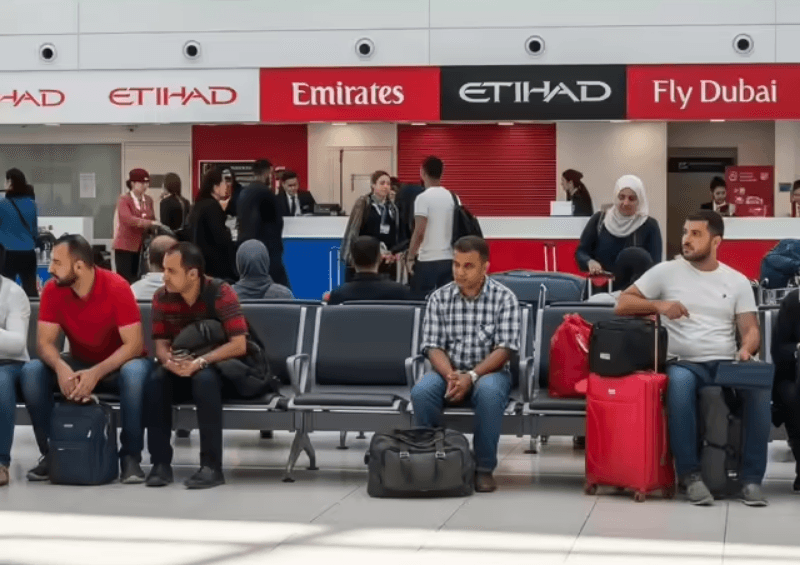
UAE supports stranded travellers in Dubai and Abu Dhabi amid airspace closures, covering hotels, meals, visas, and rebooking during Middle East aviation disruption.
UAE Aviation Crisis: What Happened?
The United Arab Emirates has become the focal point of a major aviation disruption following sudden airspace restrictions triggered by escalating regional tensions in the Middle East.
Major hubs including Dubai (DXB), Abu Dhabi (AUH), and Sharjah witnessed large-scale flight cancellations and rerouting. As a result, 20,000+ passengers—many of them transit travellers—were left stranded across terminals and nearby hotels.
For B2B travel stakeholders, this disruption highlights the fragility of global hub-and-spoke aviation networks, especially those heavily reliant on Gulf transit corridors.
Government Intervention: A Rare Large-Scale Move
In a decisive response, UAE authorities introduced state-backed passenger support measures, rarely seen at this scale.
Key Support Measures:
Free Accommodation: Hotels arranged for stranded passengers
Meals & Essentials: Covered by government funding
Flight Rebooking: Coordinated with airlines and airport teams
Ground Transport: Managed between airports and hotels
The General Civil Aviation Authority (GCAA) led coordination efforts alongside airlines and airport operators to maintain operational stability.
In Abu Dhabi, hotels were instructed to extend guest stays, with costs absorbed by the government—removing financial burden from travellers and travel agents.
Immigration & Transit Visa Flexibility
One of the biggest operational challenges was managing transit passengers stuck inside airport zones.
Key Immigration Actions:
30,000+ passengers processed across UAE airports
15,000+ temporary entry visas issued
Transit passengers allowed to exit airport zones and access hotels
The Federal Authority for Identity, Citizenship, Customs & Port Security (ICP) enabled fast-track processing, ensuring minimal congestion and improved passenger comfort.
For travel agents, this flexibility prevented forced rerouting and preserved onward travel plans.
Immediate Impact on Travel & Tourism Industry
The disruption has triggered multiple ripple effects across the global travel ecosystem:
Operational Challenges:
Flight cancellations and delays across Europe–Asia routes
Overbooked hotels in key UAE cities
Tour cancellations and itinerary disruptions
Commercial Impact:
Decline in short-term bookings due to uncertainty
Increased rebooking workload for agents
Pressure on airline inventory and pricing
For consolidators and corporate travel planners, this situation has required rapid itinerary restructuring and client communication.
Strategic Insight: UAE’s Reputation Management Play
Despite the crisis, the UAE’s proactive handling sends a strong signal to the global market.
Why This Matters:
Protects premium transit passenger experience
Reinforces UAE’s positioning as a reliable global hub
Reduces reputational damage during geopolitical instability
This approach aligns with long-term tourism strategy—prioritizing trust, service quality, and crisis resilience.
Long-Term Implications for B2B Travel Industry
1. Diversification of Transit Hubs
Travel planners may increasingly consider alternative routing hubs (e.g., Istanbul, Doha, Singapore) to reduce dependency on a single region.
2. Flexible Booking Systems
Demand will grow for:
Flexible fares
Dynamic rerouting capabilities
Real-time disruption alerts
3. Crisis-Ready Travel Products
Opportunity for agents to build:
Contingency-inclusive itineraries
Insurance-backed packages
AI-driven rebooking automation
Actionable Strategy for Travel Agents
Area
Recommended Action
Client Communication
Send proactive alerts + alternative routing options
Booking Strategy
Prioritize flexible fares and multi-hub itineraries
Supplier Coordination
Maintain strong airline + DMC relationships
Automation
Use AI tools for real-time disruption tracking
Conclusion: A Benchmark in Crisis Management
The UAE’s response to this aviation disruption may set a global benchmark for passenger care during large-scale crises.
While the situation exposed vulnerabilities in Middle East air corridors, it also demonstrated how swift government intervention can stabilize both passenger experience and industry confidence.
For B2B travel professionals, this is a critical reminder to build resilient, flexible, and tech-enabled travel systems that can adapt to sudden disruptions.
Want more travel updates like this? Follow our updates at blog.agentbazar.in and transform how you support your clients at every stage of travel.
Follow us on Facebook, X (Twitter), Instagram, and YouTube for the latest travel updates and insights!
About the Agent Bazar Blog
The Agent Bazar Blog is your trusted source for industry news, airfare trends, visa updates, and insights tailored for B2B travel agents, consolidators, corporate travel planners, and tour operators.
Our goal is to support travel professionals with timely, actionable content that enhances business growth, improves efficiency, and keeps you informed in a fast-changing travel industry.
Explore our articles, stay ahead with vital updates, and make smarter decisions for your travel business.
About Agent Bazar
Agent Bazar is a next-generation series fare aggregator and B2B airfare marketplace in India, developed by Tripforu Holidays Pvt Ltd (est. 2016).
Backed by over 15 years of industry experience, the platform specializes in fixed departure fares across 300+ sectors in India and key Asian countries.
With a growing network of over 10,000 registered travel agents, Agent Bazar connects consolidators and sellers with agents through a zero-commission model, unlike traditional portals that charge 5–8% in fees.
The platform empowers travel agents and consolidators with direct access to reliable inventory, real-time fare discovery, and simplified group booking tools.
🌐 Visit: agentbazar.in