Thailand’s 2026 Airport Tax Hike: What Travelers Must Know
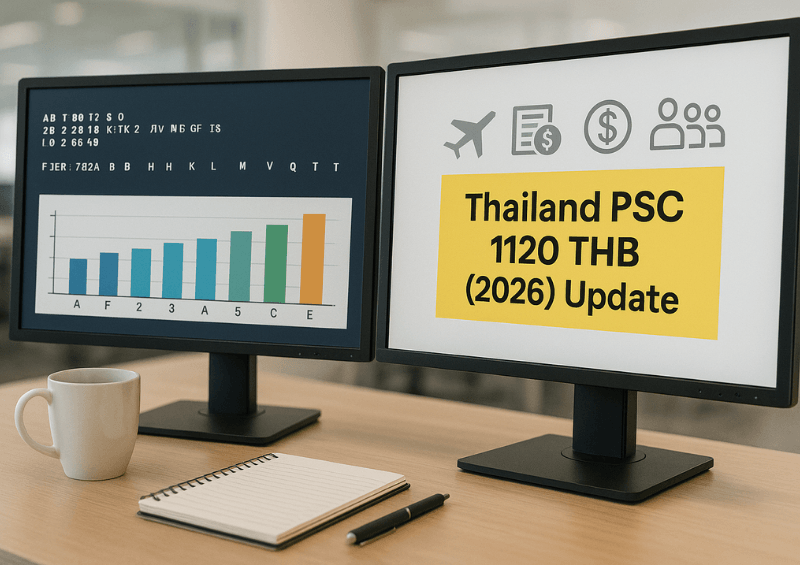
Thailand hikes the international Passenger Service Charge (PSC) from ฿730 → ฿1,120 for 2026. Learn how this 53% jump will affect fares, GDS pricing, corporate travel budgets, OTAs and advising clients on routing, promos and refund/fee admin. Keywords: Thailand airport tax 2026, PSC 1120 baht, Thai Airways.

What this means for fares and GDS/PNR pricing

For B2B sellers (agents, consolidators, TMCs, airline distribution teams):

  • The PSC is ticketed as part of the fare/airport taxes at issuance — so published fares, YQ/YR components and tax splits in GDS/booking systems will reflect the new rate once airlines and BSP/ARC processes are updated. Expect ticketing engines and BSP reconciliation to require a small release & retesting window.)

  • Airlines may absorb, partially absorb, or pass through the full increase depending on route competition, yield management and corporate contracts. On highly competitive short-haul sectors carriers could delay fare moves; on long-haul or peak leisure sectors the PSC rise will more likely show as higher total ticket prices. (Industry reaction will be airline- and market-specific.)

  • For consolidators and wholesalers: update your markup models and fare reprice rules. A fixed per-passenger increase (฿390 ≈ US$12–15) matters more for group bookings and low-fare bundles than premium itineraries.

Corporate travel impact & TMC actions

  • Corporate travel managers should revisit travel policy thresholds (per-trip caps, per-diem calculations) and notify approved travel cards / expense workflows about the change. Small per-ticket increases can compound across heavy travellers or multi-leg itineraries.

  • Update SSO and travel portal rules that flag out-of-policy trips so expense approvers aren’t surprised by slightly higher PNR totals.

  • Negotiate with carriers where possible: for high-volume corporate contracts, ask airlines/OTAs if they will offer a temporary promotional buffer or contract amendment rather than an immediate net fare increase.

Operational & distribution checklist (practical steps)

  1. GDS/CRS: Watch for circulars from Amadeus/ Sabre/Travelport about updated tax tables and test ticketing in a sandbox as soon as the new PSC is published.

  2. Inventory & Rate Shops: Reprice any dynamic packaging or packaged rates that assumed the old PSC.

  3. Group/Block bookings: Recalculate group quotes and issue addendum notices for bookings with open tickets or pending issuance.

  4. Invoicing & refunds: Ensure accounting codes and VAT/tax mapping reflect the higher PSC for accurate client invoices.

  5. Client comms: Prepare templated client advisories explaining the change and how you’ve optimized itineraries to mitigate cost

Distribution & marketing — how to keep demand steady

  • Promotions over cuts: Encourage partners and carriers to run limited-time fares or bundled ancillaries (e.g., waived baggage/seat fees for a short period) to mask the PSC uptick for price-sensitive segments.

  • Focus on value: Market upgraded airport facilities (when completed) as part of the product—faster immigration, better lounges, new South Terminal capacity at Suvarnabhumi — so travellers view the change as reinvestment rather than just a tax.

  • Routing alternatives: For price-sensitive customers, run comparative pricing (via nearby hubs) but model total trip time and ancillaries — connecting through a third country may offset tax savings or add travel-time costs.

Hotels & DMO implications (brief)

  • Hotels and destination partners should anticipate modest elasticity: budget travellers may be more price-sensitive, while luxury travellers will likely be neutral. Coordinated packages (flight + hotel specials) can smooth perception and maintain bookings.

What agents should tell end-clients (short scripts)

  • Leisure client: “There’s a small change to Thailand’s airport departure charge starting early 2026 — about ฿390 extra on your ticket. We can lock current fares now or explore promotional bundles to reduce out-of-pocket impact.”

  • Corporate traveller: “We’re updating expense policies and will pre-authorize slightly higher per-ticket costs; confirm if you want us to re-book earlier travel dates to avoid the new charge.”

Risk & monitoring (what to watch next)

  • Official AOT/CAAT public notices and the GDS supplier circulars (Amadeus, Sabre, Travelport) — they’ll contain the exact effective date and ticketing instructions.

  • Markett reaction: route yields, low-cost carrier pricing, and any short-term promotional responses from majors like Thai Airways or Singapore Airlines.

Conclusion — quick takeaways for B2B travel pros

  • The PSC rise to ฿1,120 is real and imminent — expect higher ticket totals, especially visible to price-sensitive guests and group bookings.

  • Immediate priorities: test ticketing, update pricing/rules, notify corporate clients, and coordinate with airline partners on promotion strategies.

  • View this as an operational change to manage (not a demand killer): AOT’s stated reinvestment (new terminal capacity and facilities) can become a marketing advantage if your product and client messaging align. 

Want more travel updates like this? Follow our updates at blog.agentbazar.in and transform how you support your clients at every stage of travel.

🌍 Stay Connected with the Travel Community

Follow us on Facebook, X (Twitter), Instagram, and YouTube for the latest travel updates and insights!

About the Agent Bazar Blog

The Agent Bazar Blog is your trusted source for industry news, airfare trends, visa updates, and insights tailored for B2B travel agents, consolidators, corporate travel planners, and tour operators.

Our goal is to support travel professionals with timely, actionable content that enhances business growth, improves efficiency, and keeps you informed in a fast-changing travel industry.

Explore our articles, stay ahead with vital updates, and make smarter decisions for your travel business.

About Agent Bazar

Agent Bazar is a next-generation series fare aggregator and B2B airfare marketplace in India, developed by Tripforu Holidays Pvt Ltd (est. 2016).

Backed by over 15 years of industry experience, the platform specializes in fixed departure fares across 300+ sectors in India and key Asian countries.

With a growing network of over 10,000 registered travel agents, Agent Bazar connects consolidators and sellers with agents through a zero-commission model, unlike traditional portals that charge 5–8% in fees.

The platform empowers travel agents and consolidators with direct access to reliable inventory, real-time fare discovery, and simplified group booking tools.

🌐 Visit: agentbazar.in