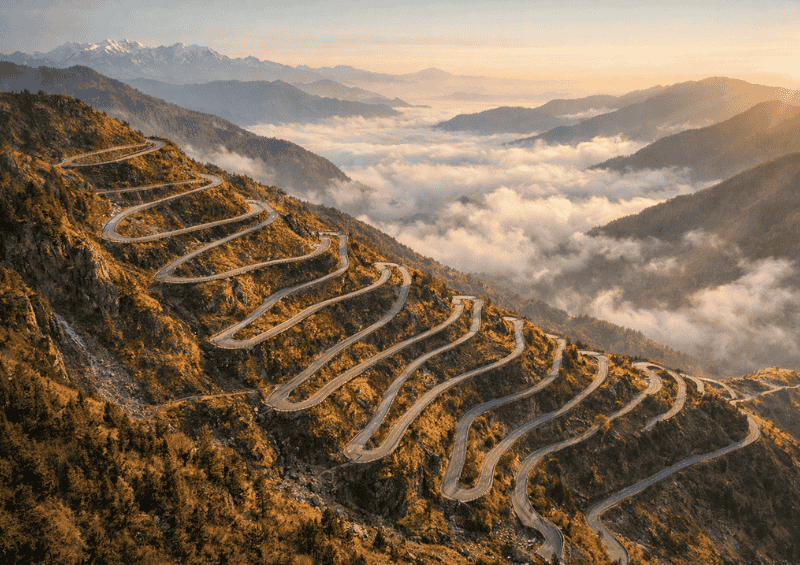
Sikkim’s Silk Route is emerging as India’s most scenic Himalayan road trip for 2025. Discover Zuluk’s legendary loops, Nathang Valley’s alpine beauty, and Tsomgo Lake’s glacial charm along this historic trade corridor connecting India to Tibet.
Sikkim’s Silk Route Emerges as India’s Most Scenic Himalayan Journey
The Silk Route Circuit in Sikkim has rapidly become one of India’s most talked-about travel corridors for 2025. Recognized as one of the most scenic drives in the country, this historic mountain route offers travelers a rare blend of Himalayan landscapes, cultural heritage, and high-altitude adventure.
Stretching roughly 900 kilometers across the eastern Himalayas, the ancient trade route once connected Lhasa in Tibet to the Bay of Bengal, enabling merchants, monks, and traders to move goods across challenging terrain.
Today, the revived circuit has transformed into a bucket-list road journey for explorers, photographers, and experiential travelers seeking destinations beyond mainstream Himalayan routes.
For travel professionals, the Silk Route also represents a fast-growing niche product in India’s adventure and experiential tourism segment.
Rongli: The Gateway to the Silk Route
Most Silk Route itineraries begin at Rongli, a picturesque Himalayan village that acts as the official entry point into the circuit.
Located near the Teesta River, Rongli offers travelers a gentle introduction to the rugged beauty of eastern Sikkim.
Visitors can explore the local market for traditional handicrafts, regional produce, and cultural artifacts, while adventure travelers often enjoy activities like river angling and rafting nearby.
For tour operators and travel agents, Rongli is the primary permit checkpoint and logistics hub before the ascent into higher Himalayan terrain begins.
Lingtam: Rhododendron Forests and Himalayan Serenity
The next major stop along the circuit is Lingtam, a peaceful Himalayan hamlet surrounded by dense rhododendron forests.
Spring transforms this region into a spectacular landscape as blooming rhododendrons paint the hillsides with bright red, pink, and purple hues.
Travelers often use Lingtam as a base for short treks toward Kupup Lake and Elephant Lake, two lesser-known but stunning alpine destinations.
Local homestays here provide an authentic glimpse into traditional Sikkimese hospitality, a key element of the Silk Route experience.
Aritar: A Blend of Nature and Spiritual Heritage
Further along the route lies Aritar, a destination known for its serene lakes and spiritual landmarks.
The highlight here is Lampokhari Lake, one of the oldest natural lakes in Sikkim, surrounded by dense forests and scenic mountain views.
Nearby, the Aritar Monastery provides visitors with insight into Buddhist traditions and architecture that have shaped the cultural identity of the region.
For travelers seeking a slower, reflective experience, Aritar offers a perfect balance between nature, spirituality, and Himalayan tranquility.
Phadamchen: A Hidden Paradise for Nature Lovers
Nestled amid alpine forests, Phadamchen is widely known among nature enthusiasts for its biodiversity and birdwatching opportunities.
The village sits within a landscape of lush hills, pristine streams, and Himalayan wildlife habitats.
Nearby viewpoints provide sweeping vistas of surrounding valleys, while the Reshi Khola riverbanks offer peaceful picnic spots.
For eco-tourism operators, Phadamchen presents strong potential for nature-focused itineraries and slow travel experiences.
Zuluk: Legendary Himalayan Hairpin Bends at 10,000 Feet
One of the most iconic locations on the Silk Route is Zuluk, a historic settlement perched at approximately 10,000 feet above sea level.
Zuluk once functioned as a key transit station for traders moving goods between Tibet and India.
Today it is famous for its dramatic zig-zag mountain road, often photographed from the Thambi Viewpoint, where travelers can see more than 30 hairpin bends winding through the mountains.
This section of the route is widely considered one of the most photogenic mountain drives in Asia.
Nathang Valley: The “Ladakh of East India”
At nearly 13,500 feet, Nathang Valley offers a dramatic alpine landscape often compared to Ladakh.
Depending on the season, the valley transforms into either:
A snow-covered winter wonderland, or
A wildflower-covered alpine meadow in summer
The silence of the valley, broken only by wind and yak bells, creates a truly surreal atmosphere.
For photographers, filmmakers, and adventure travelers, Nathang Valley is often the most memorable highlight of the Silk Route journey.
Tsomgo (Changu) Lake: A Sacred Glacial Jewel
Another major highlight is Tsomgo Lake, also known as Changu Lake, a glacial lake located at about 12,300 feet above sea level.
Surrounded by snow-covered peaks and fluttering prayer flags, the lake holds strong spiritual significance for local communities.
Visitors can enjoy yak rides, scenic viewpoints, and seasonal color changes in the lake’s water, making it one of the most photographed locations in Sikkim.
Cultural Heritage and Responsible Tourism
The Silk Route is not just about scenery. It is a living cultural corridor filled with historical markers, ancient stone carvings, and remnants of the original trade route.
To preserve this fragile ecosystem, the Government of Sikkim actively promotes responsible tourism, encouraging controlled visitor flows and eco-friendly travel practices.
Homestay programs along the route allow travelers to connect with local communities while also supporting sustainable tourism development.
Why the Silk Route Matters for the Travel Industry
For travel agents and tour operators, the Silk Route presents a high-potential experiential product.
Key opportunities include:
Small group adventure tours
Premium Himalayan road trips
Photography expeditions
Slow travel and homestay experiences
Luxury offbeat itineraries
As travelers increasingly seek less crowded destinations and authentic cultural experiences, the Silk Route stands out as a strong emerging alternative to over-touristed Himalayan destinations.
Conclusion: A Rising Star in India’s Experiential Tourism Market
Sikkim’s Silk Route is quickly gaining recognition as one of the most scenic and culturally rich road journeys in Asia.
From the winding roads of Zuluk to the high-altitude serenity of Nathang Valley, the circuit offers a rare opportunity to explore a historic trade path surrounded by breathtaking Himalayan landscapes.
For travel professionals, the Silk Route is more than just a destination — it is an experiential travel product with strong future demand in India’s growing adventure tourism market.
Want more travel updates like this? Follow our updates at blog.agentbazar.in and transform how you support your clients at every stage of travel.
Follow us on Facebook, X (Twitter), Instagram, and YouTube for the latest travel updates and insights!
About the Agent Bazar Blog
The Agent Bazar Blog is your trusted source for industry news, airfare trends, visa updates, and insights tailored for B2B travel agents, consolidators, corporate travel planners, and tour operators.
Our goal is to support travel professionals with timely, actionable content that enhances business growth, improves efficiency, and keeps you informed in a fast-changing travel industry.
Explore our articles, stay ahead with vital updates, and make smarter decisions for your travel business.
About Agent Bazar
Agent Bazar is a next-generation series fare aggregator and B2B airfare marketplace in India, developed by Tripforu Holidays Pvt Ltd (est. 2016).
Backed by over 15 years of industry experience, the platform specializes in fixed departure fares across 300+ sectors in India and key Asian countries.
With a growing network of over 10,000 registered travel agents, Agent Bazar connects consolidators and sellers with agents through a zero-commission model, unlike traditional portals that charge 5–8% in fees.
The platform empowers travel agents and consolidators with direct access to reliable inventory, real-time fare discovery, and simplified group booking tools.
🌐 Visit: agentbazar.in