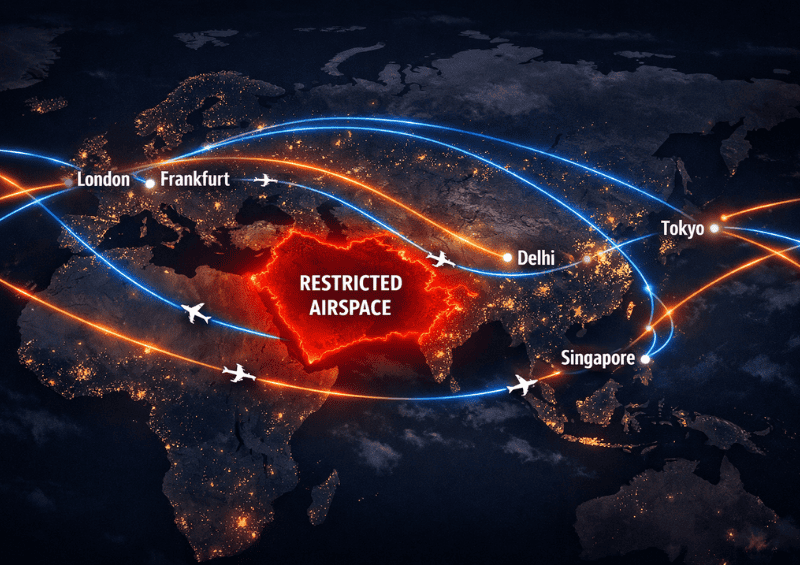
Middle East airspace closures disrupt global aviation, sending flight prices soaring and forcing airlines to reroute Asia–Europe routes. Discover how the 2026 aviation crisis impacts travel agents, airlines, and global connectivity.
A Sudden Shock to Global Aviation Networks
The global aviation industry is currently experiencing one of its most significant disruptions in recent years. The escalation of geopolitical tensions in the Middle East during late February 2026 has led to widespread airspace closures across key Gulf states, dramatically affecting global flight operations.
Countries including Iran, Qatar, the UAE, Bahrain, Iraq, and Israel temporarily restricted or closed portions of their airspace after military strikes triggered regional instability. These closures forced airlines to suspend, divert, or reroute thousands of flights across international corridors connecting Asia, Europe, and North America.
For travel agents, consolidators, and corporate travel planners, the implications are immediate:
Limited seat availability
Longer routing times
Higher operational costs for airlines
Rapidly increasing airfare prices
The Collapse of Major Gulf Transit Hubs
For decades, airports in Dubai, Doha, and Abu Dhabi have served as critical transit hubs linking East and West. Airlines like Emirates, Qatar Airways, and Etihad Airways built global networks around these high-capacity hubs.
However, the recent crisis forced temporary closures and heavy operational restrictions at these airports, creating a sudden gap in global seat capacity. Industry estimates show thousands of flights cancelled and hundreds of thousands of passengers stranded or rerouted.
This disruption has created a ripple effect across international aviation networks.
Immediate consequences for travel agents
Popular long-haul routes showing “sold out” weeks in advance
Significant fare increases on Asia–Europe sectors
Sudden schedule changes and airline suspensions
The Great Reroute: Airlines Rebuilding Global Flight Paths
With Gulf airspace restricted, airlines are rapidly redesigning their global flight paths.
Instead of traditional routes through the Middle East, many carriers are now rerouting flights via:
Central Asia and the Caucasus
Northern routes through Eastern Europe
Southeast Asian hubs such as Singapore
Trans-Pacific routes via North America
Some Asia–Europe flights are even traveling eastward across the Pacific to North American hubs like Los Angeles or Houston before continuing to Europe, adding significant travel time.
These alternative routings can add 8–12 hours to journey times, increasing fuel costs, crew duty complexities, and aircraft scheduling challenges.
For travel professionals, this means increased itinerary complexity and more proactive client communication.
Demand Surge at Alternative Aviation Hubs
With Gulf mega-hubs partially unavailable, demand is shifting toward other global aviation centers.
Airlines operating through the following hubs are experiencing sudden booking surges:
Singapore
Hong Kong
Istanbul
Beijing
Seoul
Carriers such as Cathay Pacific, Singapore Airlines, and Turkish Airlines are seeing increased traffic from passengers seeking routes that avoid the conflict zone.
For B2B travel agents, this shift highlights the importance of diversifying airline partnerships and routing options.
European Tourism Faces Uncertain Summer Season
The crisis is also raising concerns within Europe’s tourism sector.
Many European destinations rely heavily on long-haul visitors from Asia, particularly travelers connecting through Gulf carriers. With reduced flight capacity and higher ticket prices, tourism authorities are concerned about:
Lower Asian arrivals
Reduced luxury retail spending
Declining hotel occupancy in major cities
Destinations that depend less on long-haul air connectivity may be better positioned during this period of uncertainty.
Why Some Destinations Are Less Impacted
Not all destinations are equally affected by the aviation disruption.
Countries that rely more on regional travelers or road tourism may experience less impact. For example, European destinations accessible via rail or highway networks continue to attract visitors from neighboring countries.
This trend highlights a broader industry shift toward regional travel resilience during global aviation disruptions.
Rising Fuel Costs Are Increasing Travel Prices
The impact of the crisis extends beyond flight availability.
Fuel prices have risen due to geopolitical tensions in oil-producing regions, increasing airline operating costs. As a result, many carriers are implementing:
Higher fuel surcharges
Fare adjustments on long-haul routes
Reduced promotional fares
These costs are also impacting the hospitality sector. Hotels and resorts facing rising energy expenses may increase room rates, particularly in energy-intensive destinations.
Safety and Stability Become Key Travel Decision Factors
In 2026, travelers are prioritizing destinations that demonstrate strong safety infrastructure and stable connectivity.
Tourism boards and governments are emphasizing crisis management capabilities and operational resilience to reassure travelers.
For travel advisors and corporate travel managers, risk assessment and route monitoring have become essential parts of travel planning.
What Travel Agents Should Do Now
For B2B travel professionals, this evolving situation requires proactive strategy.
Key actions to consider
1. Book earlier than usual
Inventory is tightening quickly across major long-haul routes.
2. Expand airline options
Consider carriers operating through alternative hubs such as Singapore, Istanbul, and Seoul.
3. Monitor airline advisories daily
Schedules and routes are changing frequently.
4. Build flexible itineraries
Allow additional buffer time for rerouted flights.
5. Prepare clients for higher airfares
Transparent communication helps manage expectations.
The Road Ahead for Global Aviation
Industry analysts believe that global aviation networks may take several months to stabilize if tensions persist. Airlines are adapting by redesigning flight paths, adjusting fleet deployment, and prioritizing high-demand routes.
However, longer routes, higher fuel consumption, and reduced seat supply may keep international airfares elevated throughout much of 2026.
For travel agents and aviation professionals, adaptability and information access will be the key competitive advantage during this period.
Conclusion: A New Reality for Global Travel Planning
The Middle East aviation disruption highlights how geopolitical events can reshape global connectivity overnight.
For the travel industry, this moment underscores three important realities:
Global aviation networks are highly interconnected
Airline routing strategies must remain flexible
Travel professionals must stay informed to guide clients effectively
Agents who proactively monitor airline updates, diversify routing options, and communicate clearly with clients will be best positioned to navigate this evolving landscape.
Want more travel updates like this? Follow our updates at blog.agentbazar.in and transform how you support your clients at every stage of travel.
Follow us on Facebook, X (Twitter), Instagram, and YouTube for the latest travel updates and insights!
About the Agent Bazar Blog
The Agent Bazar Blog is your trusted source for industry news, airfare trends, visa updates, and insights tailored for B2B travel agents, consolidators, corporate travel planners, and tour operators.
Our goal is to support travel professionals with timely, actionable content that enhances business growth, improves efficiency, and keeps you informed in a fast-changing travel industry.
Explore our articles, stay ahead with vital updates, and make smarter decisions for your travel business.
About Agent Bazar
Agent Bazar is a next-generation series fare aggregator and B2B airfare marketplace in India, developed by Tripforu Holidays Pvt Ltd (est. 2016).
Backed by over 15 years of industry experience, the platform specializes in fixed departure fares across 300+ sectors in India and key Asian countries.
With a growing network of over 10,000 registered travel agents, Agent Bazar connects consolidators and sellers with agents through a zero-commission model, unlike traditional portals that charge 5–8% in fees.
The platform empowers travel agents and consolidators with direct access to reliable inventory, real-time fare discovery, and simplified group booking tools.
🌐 Visit: agentbazar.in