Iran Airspace Closure Disrupts Global Flights in 2026
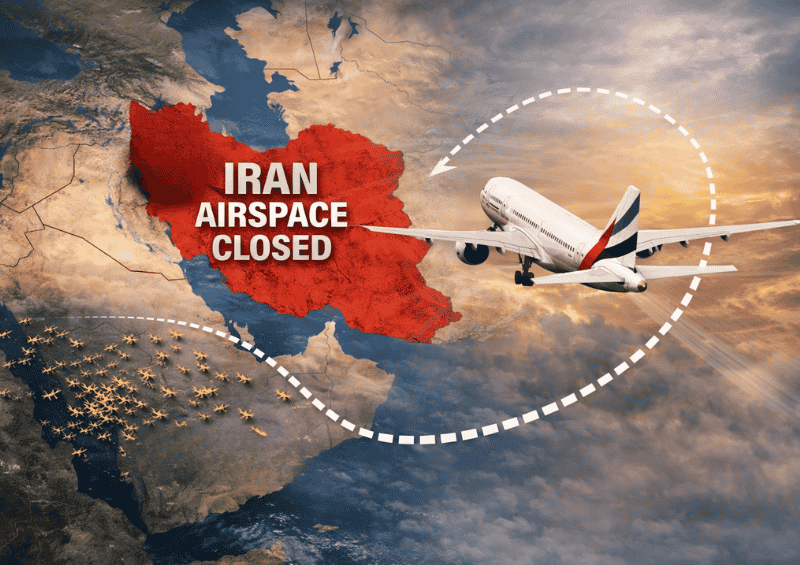
Rising US–Iran tensions force airlines to avoid Iranian airspace, causing flight diversions, delays, and cancellations. A critical aviation update for B2B travel agents, corporate planners, and airline professionals.

A Rapid Escalation with Immediate Aviation Impact

In mid-January 2026, geopolitical tensions between the United States and Iran intensified sharply, creating immediate disruption across global aviation networks. Within hours of heightened military warnings, Iran temporarily restricted access to its airspace, triggering widespread flight diversions, delays, and cancellations across Europe, Asia, and North America.

For B2B travel agents, consolidators, and corporate travel managers, this event highlighted once again how fragile long-haul routing remains when conflict risks intersect with busy international corridors.

Temporary Iranian Airspace Restriction: What Happened

Iran imposed a short-notice airspace limitation lasting nearly five hours on January 14, 2026. Only select international flights operating to or from Iranian airports were permitted during this window, while transit traffic was forced to divert or delay.

Flight-tracking platforms recorded dozens of aircraft changing course mid-flight, returning to origin points, or holding until clearance was restored. Iranian carriers were among the first to resume operations once restrictions were lifted, but the disruption had already cascaded across multiple regions.

Long-Standing US Restrictions Over the Tehran FIR

Well before the January 2026 event, the United States had already prohibited its carriers from operating in the Tehran Flight Information Region. Under a standing FAA regulation, US-registered aircraft and operators remain barred from Iranian airspace due to persistent safety risks linked to regional military activity and air-defence readiness.

The FAA extended this restriction through October 2027, reinforcing concerns that civil aircraft could be misidentified during periods of heightened alert—an issue underscored by past aviation tragedies in the region.

European Safety Warnings Intensify

European regulators echoed similar concerns. Germany issued an updated NOTAM in January 2026 advising its civil operators to avoid Iranian airspace entirely due to elevated threat levels. Italy followed with strengthened guidance requiring enhanced risk assessments before any operation through the region.

The European Union Aviation Safety Agency also maintained an active conflict-zone advisory, urging all operators to factor Iranian airspace risks into flight planning at all altitudes.

Why Airlines Are Steering Clear of Iran

The primary risk lies in misidentification. During periods of military tension, civilian aircraft can be mistaken for hostile targets, particularly when missile activity, drone operations, or electronic interference are present.

Aviation risk monitors have repeatedly flagged:

  • Limited advance notice for military exercises

  • Missile and drone tests near international air routes

  • GPS signal interference affecting navigation reliability

For airlines, avoiding the region has become a risk-management necessity rather than a precaution.

Airline Responses: Europe, India, and Beyond

Major global carriers moved swiftly to adjust operations.

The Lufthansa Group publicly confirmed that all its airlines would avoid Iranian and Iraqi airspace until further notice, resulting in longer flight times across Europe–Asia and Europe–Middle East routes.

Indian carriers were also significantly affected. Air India cancelled multiple long-haul services and rerouted Europe- and US-bound flights, warning passengers of extended journey times. IndiGo adopted alternative routings via Saudi airspace and flagged possible cancellations on select Central Asia routes.

No US commercial airline currently overfly Iran, while several Gulf and Eurasian carriers either rerouted or temporarily suspended services during the peak of the disruption.

Operational Impact on Routes and Costs

Avoiding Iranian airspace adds hundreds of kilometres to many long-haul sectors. Common consequences include:

  • Increased fuel burn

  • Longer block times

  • Crew duty-time challenges

  • Higher operational costs

  • Increased risk of knock-on delays

For corporate travel planners and consolidators, these changes complicate fare construction, connection planning, and service reliability.

Broader Security Environment and Travel Advisories

The aviation disruption coincided with wider regional warnings. Multiple governments issued advisories urging caution or temporary departure from Iran, reflecting fears that airports and infrastructure could become secondary targets during escalation.

Ongoing regional instability, communication blackouts, and civil unrest further heighten operational uncertainty for airlines and travel managers alike.

Key Takeaways for B2B Travel Professionals

The January 2026 Iranian airspace disruption reinforces several critical lessons:

  • Conflict-zone airspace remains highly volatile, even during short-term escalations

  • Regulatory guidance from the FAA, EASA, and national authorities directly shapes airline routing decisions

  • Flight schedules, costs, and reliability can change with little notice

For travel agents and corporate planners, proactive communication with clients and continuous monitoring of aviation advisories are now essential parts of service delivery.

Conclusion: Planning in an Era of Geopolitical Volatility

As US–Iran tensions remain unresolved, airlines are expected to continue avoiding Iranian airspace well into 2026. The convergence of regulatory bans, national NOTAMs, and airline safety assessments reflects a unified industry approach: prioritising passenger and crew safety over operational efficiency.

For B2B travel stakeholders, staying informed is no longer optional—it is a competitive advantage.

Want more travel updates like this? Follow our updates at blog.agentbazar.in and transform how you support your clients at every stage of travel.


🌍 Stay Connected with the Travel Community

Follow us on Facebook, X (Twitter), Instagram, and YouTube for the latest travel updates and insights!

About the Agent Bazar Blog

The Agent Bazar Blog is your trusted source for industry news, airfare trends, visa updates, and insights tailored for B2B travel agents, consolidators, corporate travel planners, and tour operators.

Our goal is to support travel professionals with timely, actionable content that enhances business growth, improves efficiency, and keeps you informed in a fast-changing travel industry.

Explore our articles, stay ahead with vital updates, and make smarter decisions for your travel business.

About Agent Bazar

Agent Bazar is a next-generation series fare aggregator and B2B airfare marketplace in India, developed by Tripforu Holidays Pvt Ltd (est. 2016).

Backed by over 15 years of industry experience, the platform specializes in fixed departure fares across 300+ sectors in India and key Asian countries.

With a growing network of over 10,000 registered travel agents, Agent Bazar connects consolidators and sellers with agents through a zero-commission model, unlike traditional portals that charge 5–8% in fees.

The platform empowers travel agents and consolidators with direct access to reliable inventory, real-time fare discovery, and simplified group booking tools.

🌐 Visit: agentbazar.in