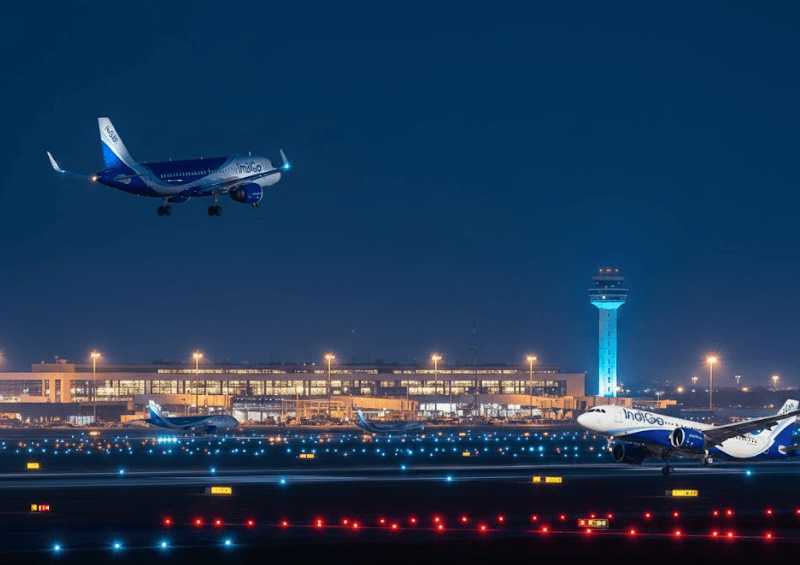
In December 2025, India’s busiest airline, IndiGo, faced one of the most severe operational crises in the country’s aviation history — not due to aircraft issues, but because of regulatory crew rest requirements that collided head-on with its night-centric schedule. The fallout forced the airline to seek a temporary exemption from the Directorate General of Civil Aviation (DGCA), highlighting structural stress points in even the most dominant carriers.
✈️ The Reality of IndiGo’s Night Skies Dominance
IndiGo’s operational strategy isn’t just large — it’s night-leaning. Between midnight and 6 a.m., the airline operates more domestic takeoffs and landings than all other carriers combined. This has given IndiGo unmatched aircraft utilisation and market coverage during low-demand hours, but also a deeper dependence on crew availability in a period now regulated more strictly.
Industry flight schedules from November showed IndiGo operating nearly 2,000 domestic flights weekly, dwarfing competitors like Air India, SpiceJet, and Akasa Air in late-night and early-morning segments.
🕰️ What Changed: New FDTL Regulations
The DGCA’s revised Flight Duty Time Limitation (FDTL) norms — rolled out in phases and fully implemented from 1 November 2025 — were designed to tackle pilot fatigue with tighter rest rules and stricter night duty limits. These included:
Extended night duty window (midnight–6 a.m.),
Limits on weekly night landings, and
Increased mandatory rest periods for pilots.
While the intent was safety-driven, the practical impact on crew rostering and night operations was immediate — particularly for airlines like IndiGo that heavily rely on overnight flight rotations.
🚨 Operational Impact on IndiGo
From early December, the airline’s on-time performance plummeted and cancellations skyrocketed — at one point exceeding 1,600 flights canceled in a single day — as pilot rosters failed to comply with the new duty limits.
The disruptions weren’t only due to regulatory changes. Contributing factors included:
Crew rostering system limitations
Seasonal weather challenges and winter fog
High winter travel demand
Rapid expansion without proportional staff augmentation
Collectively, these forces exposed a thin margin for error in a network built on tight turnaround times and lean crew numbers.
🛂 Why IndiGo Requested a DGCA Exemption
Faced with sustained schedule instability, IndiGo sought — and was granted — a temporary DGCA waiver on key night duty provisions until 10 February 2026.
Under this exemption:
The definition of “night duty” was rolled back to midnight–5 a.m.,
Night landing limits were relaxed back to six landings per roster, and
Certain weekly rest requirements became temporarily more flexible.
This breathing room allowed the airline to reset its schedule, improve crew utilisation, and gradually restore flight stability without immediate regulatory penalties.
👩✈️ Industry Reaction: Safety vs. Stability
Not everyone welcomed the exemption:
Pilot associations argued that relaxing rest requirements undermines safety safeguards designed to reduce fatigue risks.
Some competitors — who had prepared better for the rules — saw the move as unfair, allowing IndiGo to benefit from planning shortfalls others avoided.
Despite criticism, regulators balanced safety with the broader public interest, acknowledging that a collapse of India’s dominant airline could interrupt the entire domestic network.
📊 Key Takeaways for Aviation Professionals
For travel agents, airlines, and corporate travel planners, this episode is a powerful reminder of how regulatory shifts ripple across the ecosystem:
Crew planning and rostering systems must be robust to absorb changes in duty regulations.
Night operations optimization is a competitive advantage, but also a vulnerability if regulatory alignment is weak.
Proactive engagement with aviation authorities and early scenario planning help mitigate disruption impacts.
Understanding these dynamics can guide smarter contract negotiations, scheduling forecasts, and risk management plans in 2026 and beyond.
🧭 Conclusion
IndiGo’s night skies dominance turned into its hardest operational test yet when the DGCA’s new FDTL norms kicked in. Its request — and receipt — of a temporary exemption shows the delicate balance between safety, regulation, and operational reality in a high-frequency market like India’s. For aviation professionals and travel partners, the episode underscores the value of strategic crew planning and adaptive operational frameworks in an industry where even small rule changes can have outsized effects.
Want more travel updates like this? Follow our updates at blog.agentbazar.in and transform how you support your clients at every stage of travel. ✈️
Follow us on Facebook, X (Twitter), Instagram, and YouTube for the latest travel updates and insights!
About the Agent Bazar Blog
The Agent Bazar Blog is your trusted source for industry news, airfare trends, visa updates, and insights tailored for B2B travel agents, consolidators, corporate travel planners, and tour operators.
Our goal is to support travel professionals with timely, actionable content that enhances business growth, improves efficiency, and keeps you informed in a fast-changing travel industry.
Explore our articles, stay ahead with vital updates, and make smarter decisions for your travel business.
About Agent Bazar
Agent Bazar is a next-generation series fare aggregator and B2B airfare marketplace in India, developed by Tripforu Holidays Pvt Ltd (est. 2016).
Backed by over 15 years of industry experience, the platform specializes in fixed departure fares across 300+ sectors in India and key Asian countries.
With a growing network of over 10,000 registered travel agents, Agent Bazar connects consolidators and sellers with agents through a zero-commission model, unlike traditional portals that charge 5–8% in fees.
The platform empowers travel agents and consolidators with direct access to reliable inventory, real-time fare discovery, and simplified group booking tools.
🌐 Visit: agentbazar.in